
(Continuation of Once a line, always a line.)
One thing I skimmed over is the way you translate the regular space into the discrete integer space that I used to place the integer objects in. That takes more effort that I can be bothered to apply here.
So, in the service of transparency and brevity, here’s a summary of the conclusions of the previous post:
- Usually an integer is represented as a point on the number line (same as non-integers, but that’s irrelevant).
- In a multidimensional space, that can be translated as a section of line, laying on one of the axis – one of the ends of the section is on the origin, the other is N units away, where N is the size of the integer.
- The prime factorization of an integer can be represented with a multidimensional object.
- The number of dimensions of the object equals the number of prime factors of the integer.
- One of the vertices of the object lays on the origin and from there, on the axis of each dimension, there is an edge with length equal one of the prime factors.
- Each such object is unique (because each prime factorization is unique)
- The object representation of a prima number is always a line – a one dimensional object.
— — —
Here’s 24 as an integer on the number line:

…and here it is as a line:
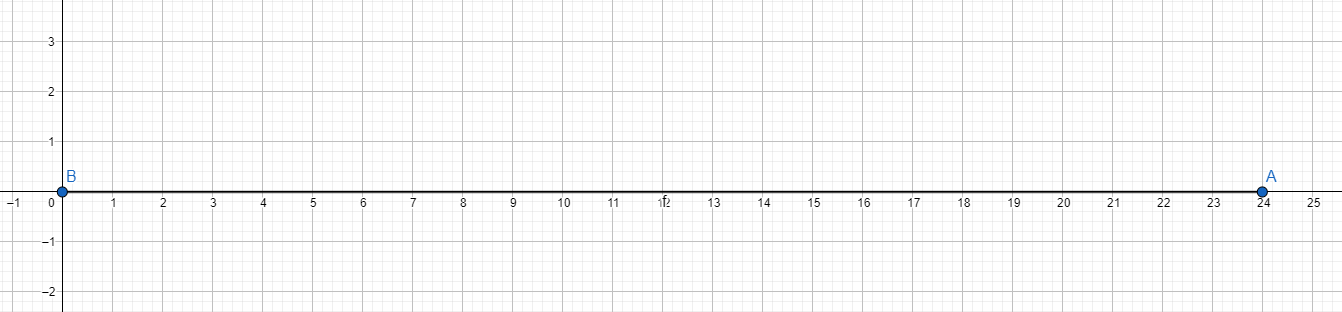
…It could be a polygon:

… but that’s just regular factorization (one of).
The prime factorization of 24 is this:

This object can be only 24 and no other object can be 24 (rotations aside, because not relevant).